
Natural Home Fragrance Hacks: Effective Recipes
Discover natural and effective home fragrance hacks using simple ingredients like baking soda and essential oils, without resorting to chemical products.
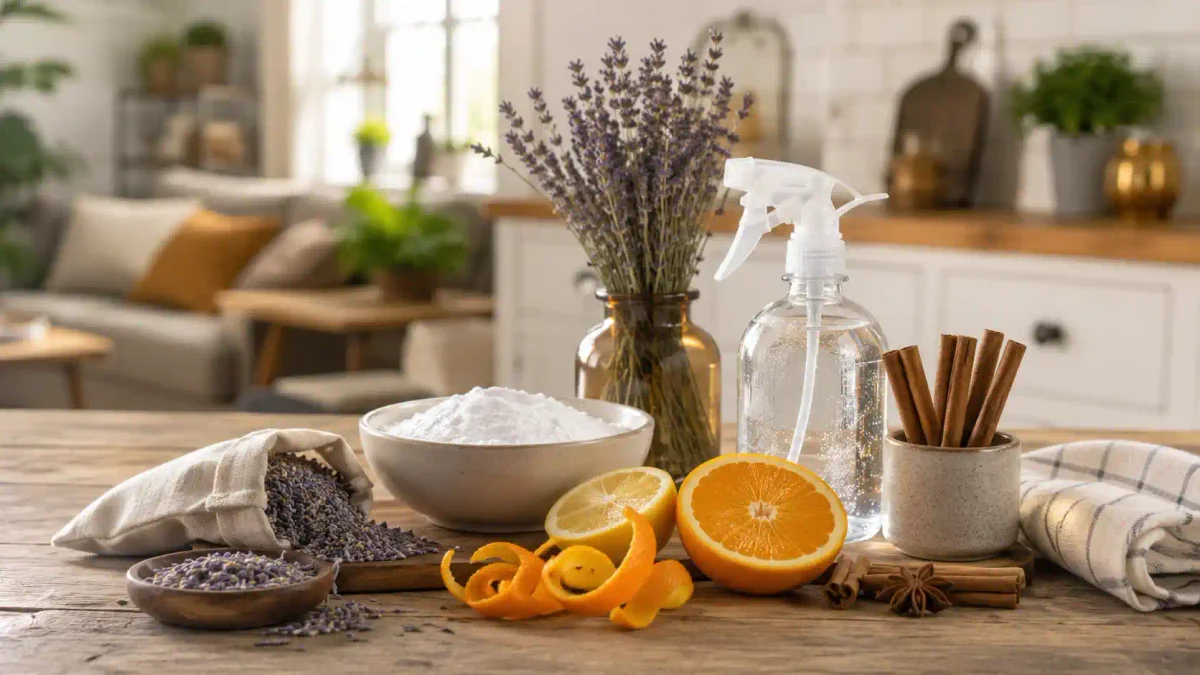
Keep Your Home Smelling Fresh Naturally
Everyday odors from cooking, pet litter, children's shoes, and humidity can accumulate quickly in our homes. Commercial air fresheners often just mask these smells temporarily while introducing unknown chemicals into the environment.
Fortunately, natural home fragrance hacks are still effective as of 2026. Ingredients like baking soda, citrus fruits, essential oils, and citric acid can help you create a non-toxic ambient fragrance that is both effective and affordable. Below are some tried-and-true recipes with the right dosages.
Baking Soda: The Foundation of a Non-Toxic Homemade Deodorizer
Why It Works
Baking soda doesn't just mask odors; it absorbs them. Its porous structure captures odor molecules like an invisible sponge, while commercial sprays merely layer a scent over existing smells.
Basic Recipe
- 3 to 4 tablespoons of baking soda in an open bowl.
- Place it in high-traffic areas such as entryways, bathrooms, or kitchens.
- Allow it to work continuously, day and night.
Where to Place It
- Refrigerator and cabinets: A small open bowl is sufficient, to be replaced every 2-3 months.
- Trash bin: Sprinkle the bottom after cleaning and drying completely before adding the bag.
- Carpets, mattresses, sofas: Generously sprinkle, let sit for at least 30 minutes (ideally overnight), then vacuum.
- Shoes: Use a tablespoon per shoe or place it in a sock at the bottom overnight.
- Drains and sinks: Pour in a few tablespoons at night and rinse with hot water in the morning.
Bonus Fragrance
Add 8 to 10 drops of essential oil directly into the baking soda in the bowl. This keeps the odor-absorbing power of baking soda while also releasing a pleasant scent gradually. It’s the simplest combination for a non-toxic homemade deodorizer that truly works, rather than just masking odors.
Homemade Essential Oil Sprays: Getting the Dosage Right
Many online recipes fail here: too much essential oil or not enough solvent results in a mixture that irritates the eyes instead of smelling good.
Basic Recipe for 100 ml
| Ingredient | Quantity | Role | |-----------------------------|----------|----------------------------------------| | 70° Alcohol or Vodka | 50 ml | Dilutes the essential oils (they don’t mix with water alone) | | Distilled Water | 25 ml | Completes the volume | | Essential Oils | 30 to 50 drops | Fragrance and sanitizing action |
Steps:
- Pour the alcohol into a glass spray bottle.
- Add the essential oils drop by drop, mixing as you go.
- Fill with distilled water.
- Let it rest for 1 hour to 24 hours before first use for the mixture to homogenize.
- Shake well before spraying.
Three Effective Combinations
- Citrus Freshness: 20 drops of lemon + 20 drops of eucalyptus + 20 drops of lavender. Ideal for living rooms and entryways.
- Cocooning: 15 drops of true lavender + 10 drops of cedarwood + 10 drops of sweet orange. Perfect for bedrooms at night.
- Clean Kitchen: 15 drops of lemon + 10 drops of peppermint + 5 drops of tea tree. Best for areas without children or pets (see below).
For a gentler scent, especially in the presence of children or in closed rooms, limit to 10-15 drops for 100 ml. This is the basic rule for maintaining a non-toxic indoor fragrance without going overboard.
Citrus Potpourri: A Zero-Waste, No-Bottle Method
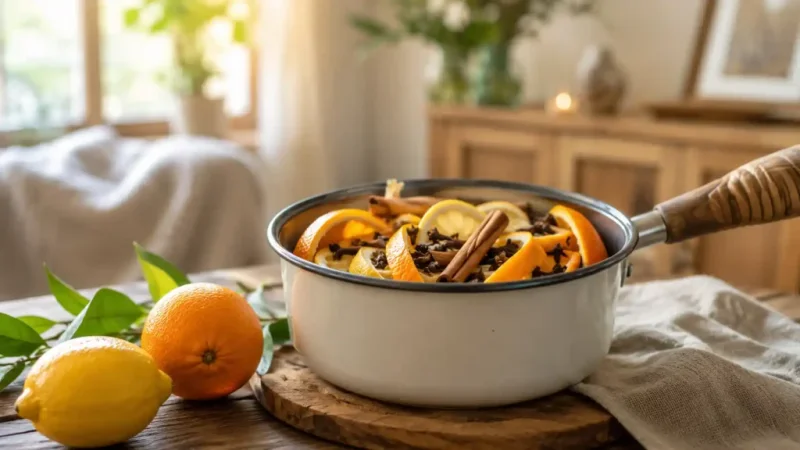
Classic Recipe
- Peels from 1 orange and 1 lemon (preferably organic, keep the skin).
- 2 cinnamon sticks.
- 3 cloves.
- 1 liter of water.
Simmer on low heat in a pot, making sure it never boils or evaporates completely. The scent fills the entire house within 20 minutes, and you can reuse the same mixture 2 to 3 times by storing it in the fridge between uses.
No-Cook Version
Place dried peels in a bowl with a few cloves and a cinnamon stick. While less potent than the simmered version, it can serve as decor on a shelf for several weeks.
Textiles and Linens: Long-Lasting Fragrance
Lavender Sachet in the Closet
A handful of dried lavender flowers in a small fabric sachet, tucked between stacks of laundry. This lasts 3 to 6 months before losing potency – simply crumple the flowers to revive the scent.
Scented Homemade Laundry
Add 5 to 8 drops of lavender or lemon essential oil directly into the fabric softener compartment. Be cautious: never add it directly to the drum as it can stain light fabrics.
White Vinegar Against Musty Odors
A glass of white vinegar in the softener compartment eliminates musty or sweat odors from towels and dishcloths without leaving a vinegar smell once the laundry is dry.
Curtains and Sofas with Tobacco or Musty Smells
Spray the homemade essential oil spray (see recipe above) from a distance of at least 30 cm, avoiding soaking the fabric.
The Kitchen: Neutralizing Cooking Odors When It Matters
During Cooking
- Simmer a little water with cloves or a cinnamon stick on the adjacent burner while cooking fish or cabbage.
- A bowl of white vinegar placed near the stove absorbs much of the greasy vapors during cooking.
After Cooking
- Simmer a halved lemon in a little water uncovered for 10 minutes: this cleans the air and scents it simultaneously.
- Open the window for 5 minutes, even in winter: nothing replaces good air circulation; no trick compensates for a kitchen that’s never aired out.
Cutting Board and Sink
Rub the board with half a lemon after cutting garlic or fish, then rinse. For the sink, a baking soda and white vinegar mixture eliminates odors rising from the drains. If the issue stems from a smelly appliance, also explore how to clean a dishwasher effectively.
Mistakes to Avoid with Natural Products
Natural hacks aren’t without risks if used improperly.
Overdosing on Essential Oils
Using more than 50 drops for 100 ml doesn’t make it more effective; it just becomes more aggressive for the respiratory system and surfaces.
Diffusing in the Presence of Babies, Pregnant Women, or Cats
- Avoid diffusing essential oils for pregnant women in the first trimester as a precaution.
- No diffusion in the presence of children under 3 years old.
- Cats are particularly sensitive: tea tree, eucalyptus, peppermint, and cinnamon can be toxic to them, even in simple diffusion in a closed room.
Mixing Baking Soda and Vinegar in a Closed Container
The chemical reaction (foam + gas) can cause an explosion in a sealed spray bottle. Always use an open container for this mixture.
Letting Saturated Baking Soda Sit
A bowl of baking soda loses its absorptive power after 2-3 weeks. If it becomes hard or clumpy, it has absorbed moisture: discard it and replace it.
Spraying on Delicate Fabrics Without Testing
Essential oils diluted in alcohol can stain silk or velvet. Always test on a hidden corner before spraying an entire sofa.
Summary Table of Recipes
| Recipe | Ingredients | Dosage | Main Use | Duration of Effect | |---------------------------|----------------------------------------------|------------------------------|----------------------------------------|--------------------------| | Baking Soda Bowl | Baking soda | 3-4 tbsp | Fridge, cabinets, trash, entry | 2-3 weeks | | Scented Baking Soda | Baking soda + essential oil | 8-10 drops for 4 tbsp | Toilets, bedroom, closet | 2-3 weeks | | Freshness Essential Oil Spray | Alcohol + water + lemon/eucalyptus/lavender | 30-50 drops/100 ml | Living room, entry, textiles | 2-3 months (bottle) | | Simmered Potpourri | Citrus + cinnamon + cloves + water | 1 orange, 1 lemon, 2 sticks/liter | Kitchen, living room, parties | 20 min per session, reusable 2-3 times | | Lavender Sachet | Dried lavender flowers | 1 handful/sachet | Closets, linen drawers | 3-6 months | | Baking Soda + Vinegar Sink| Baking soda + white vinegar | A few tbsp each | Drains, sink | As needed, renew weekly |
FAQ
What is the quickest natural hack to fragrance the home? The simmered citrus potpourri remains the fastest solution: the scent spreads throughout the home in about twenty minutes without special equipment.
Does baking soda have a smell? No, it is odorless. It doesn’t add fragrance; it absorbs existing odors. For a scent effect, pair it with a few drops of essential oil.
Can essential oils be used daily for a non-toxic indoor fragrance? Yes, provided you adhere to the dosages (30-50 drops for 100 ml in sprays, 10-15 drops in the presence of children) and avoid continuous diffusion around pregnant women, babies, or cats.
How long does a non-toxic homemade deodorizer last? It varies by format: an essential oil spray lasts a few hours on fabric, a lavender sachet lasts several months, and a baking soda bowl remains effective for 2 to 3 weeks.
Does white vinegar leave an odor after use? No, once dry, the vinegar smell completely disappears. This is precisely why it is used to neutralize odors from laundry or drains without leaving a scent trail.