
Breakthrough Discovery of Intermediate Black Hole AT2019ijn Unveils Cosmic Mystery
A research team has discovered an intermediate black hole, AT2019ijn, that tore apart a star in a dwarf galaxy, shedding light on cosmic evolution and the elusive link in astrophysics.
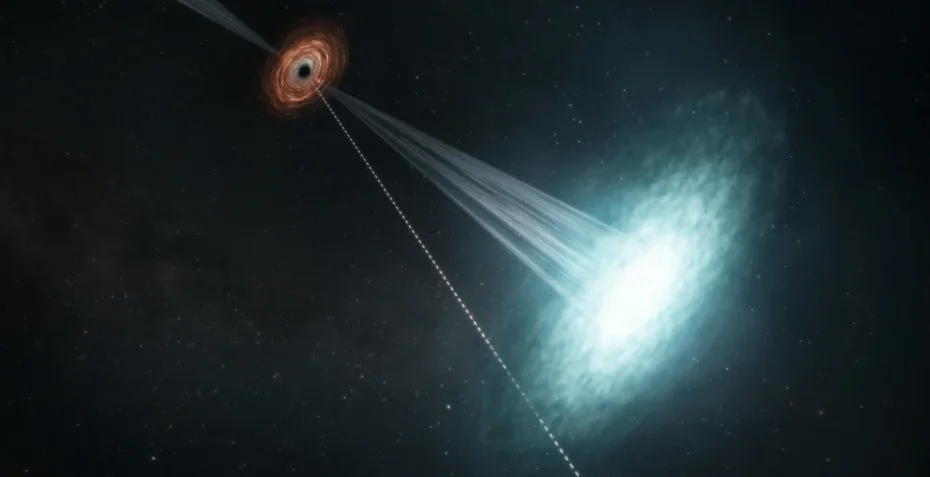
A research team has made a significant astrophysical discovery through the systematic analysis of historical datasets from the Very Large Array radio telescope in New Mexico. This investigation suggests the existence of an intermediate black hole that has torn apart a passing star in a dwarf galaxy located 3.4 billion light-years away.
This particular event, designated AT2019ijn, marks the establishment of a new astronomical category of occurrences. By closely examining the death of the star, scientists are beginning to fill a longstanding gap in the understanding of cosmic evolution.
Intermediate Black Holes: The Missing Link in Astrophysics
Intermediate black holes are considered the elusive missing link in astrophysics, bridging two known extremes. On one end are stellar black holes, formed from collapsing stars, which typically possess masses ranging from five to a hundred times that of our Sun. On the other end, supermassive black holes reside at the centers of large galaxies, boasting masses that can reach billions of solar masses. However, identifying the objects in between, which usually range from 100 to 100,000 solar masses, has proven to be extremely challenging due to their rare interactions with their surroundings.
In the case of AT2019ijn, the violent shredding of a star provided crucial evidence. When a star approaches a black hole too closely, it is torn apart by extreme gravitational forces. This process creates an accretion disk of hot gas and a relativistic jet—a stream of highly energetic matter shooting into space at nearly the speed of light. However, since the jet for AT2019ijn was not directed towards Earth, the full extent of the cosmic destruction remained hidden for an extended period.
Very Large Array Captures Delayed Signals from Space
Initially, the event was recorded in 2019 by optical telescopes as a rapid, blue optical flash. The brightness of this flash surged dramatically within a few days and then faded unusually slowly. It wasn't until nearly two years later, in 2021, that the radio emissions from the jet reached their peak and became detectable by instruments. This occurred precisely when the massive ejected material slowed enough for the radiation to spread into our line of sight.
To accurately interpret this delayed radiation, scientists utilized high-performance computers, as detailed in a study published in The Astrophysical Journal Letters. Alongside the instruments in New Mexico, complex measurement data from the Australian Square Kilometer Array Pathfinder and the Giant Metrewave Radio Telescope in Maharashtra, India, were also incorporated into the analysis. Through intricate mathematical modeling, alternative theoretical scenarios, such as the explosion of a highly magnetized neutron star, were ultimately ruled out.
Supercomputers Face Immense Data Challenges in Sky Surveys
This analytical approach not only opens a new pathway for systematically locating elusive intermediate black holes throughout the cosmos but also highlights the significant methodological and technical challenges faced by modern observational astronomy. Given that the crucial radio signals can take several years to arrive, the search for further events of this nature necessitates long-term monitoring programs that continuously gather data.
It is highly likely that within the vast existing data archives of various radio telescopes worldwide, additional, previously unrecognized signals of such celestial phenomena remain hidden. The scientific community now faces the daunting task of retroactively re-evaluating these extensive historical datasets. Whether the available computational resources in data centers are sufficient to timely address these hidden astrophysical events remains a critical question.