100 Percent Synthetic: First Division of Artificial Cell Observed
For the first time, a completely artificial cell capable of division has been created. This development fuels hopes for future new therapies and environmentally friendly production methods.
At the University of Minnesota, a world premiere has reportedly taken place. For the first time, a "cell-like system" has been created entirely from laboratory chemicals, which undergoes a complete life cycle, according to a team led by Kate Adamala from the University of Minnesota on the preprint server BiorXiv. "We have replicated in chemistry what was previously only possible in biology: It proves that the most fundamental functions of life, such as growth and reproduction, do not require a mysterious, magical spark," says Adamala. However, an independent review of the research results is still pending.
The artificial cell, dubbed "SpudCell" by the team, can take in nutrients, replicate its genome, and divide—just like biological cells do. And, just like in nature, selection and competition occur over several generations, the researchers report.
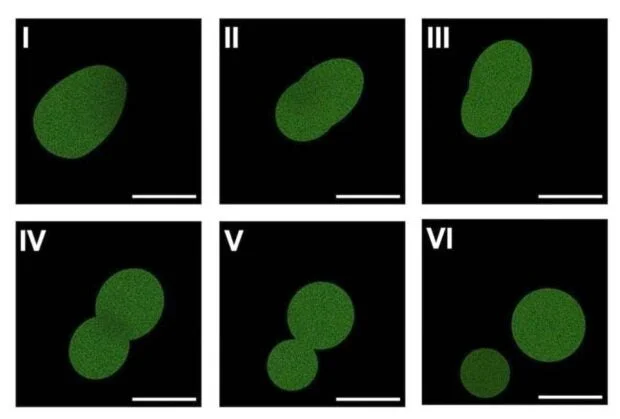
Fluorescence microscopic image of SpudCell—a synthetic cell composed entirely of non-living chemical components—during cell division. (Image: Kate Adamala, Adamala Lab)
However, the team does not wish to label their lab creation as "living." This is also a matter of definition, they say. Additionally, the artificial cell does not currently function autonomously; it only operates when chemicals are continuously supplied. Due to a lack of ribosomes, it cannot independently produce "vital" proteins and enzymes. Moreover, cell division currently only functions for a maximum of ten generations.
The genome of the novel cell is also only limitedly comparable to natural counterparts. It contains about 90,000 base pairs, significantly fewer than a human cell, which has over three billion base pairs. Another difference: The information encoded over the base pairs is not on a common DNA but on several DNA molecules. This increases the risk of losing information during cell division.
Vision: Cells Instead of Factories
Nonetheless, if the results withstand independent scrutiny, the promises of synthetic biology would be a step closer. Cleverly designed artificial cells are considered an important tool for better understanding biological processes. And—thinking even further—they could potentially replace traditional factories in the future. They would be capable of producing medical compounds, work, and industrial raw materials without aggressive chemicals and with significantly lower energy consumption than before.
"We could see materials that are grown rather than synthesized, and production methods that occur at biological rather than industrial temperatures," states the press release from the Minnesota team. However, of course, there would also be the potential for misuse of the new "life forms" and unwanted, harmful effects.
Life from the Laboratory: Researchers Have Been Working on This for Over 100 Years
The idea of an artificial cell is not new. For more than a hundred years, researchers have been trying to recreate life in the lab, from individual cell components to entire cells. Canadian physicist Thomas Chang presented the first constructs made from artificially produced membranes in 1957 and later referred to them as artificial cells.
A milestone in synthetic biology is considered to be a development from the J. Craig Venter Institute in the USA. Researchers chemically reconstructed the genome of a bacterial cell and then integrated it into a correspondingly stripped-down natural cell. The bacterium then had a basic setup of 473 artificial genes and behaved fundamentally like a natural organism. Such constructs, referred to as "minimal cells," were reported by the research team three years ago to also engage in evolution in Nature.
100 Percent Synthetic: "An Important First Step"
John Glass, research director at the J. Craig Venter Institute, is reportedly impressed by the new cell system made from 100 percent artificial ingredients from Minnesota. "The team led by Kate Adamala has designed and built a synthetic cell that comes much closer to 'life' than anything else that has been developed in the field of bottom-up synthetic cells," he told the New York Times.
The judgment of biochemist Juli Peretó from the University of Valencia is also predominantly positive: "The results seem quite spectacular to me, as it has been possible to stimulate the cells to divide with a relatively small number of components. Although the system is not particularly sustainable, as it cannot maintain itself for very long, it is still an important first step," he writes to the Spanish Science Media Center.
Adamala and her team aim to advance the technology in the coming years together with researchers from around the world. For this purpose, they have just established the research institution Biotic. The goal is to consolidate the current seven DNA plasmids of the cell into a single, more stable genome and to "build further molecular machinery," they state.