
The Moon's Geological Activity: Implications for Future Missions
The Moon's geological activity poses challenges for future Artemis missions, as new findings reveal seismic activity and shrinking dimensions.
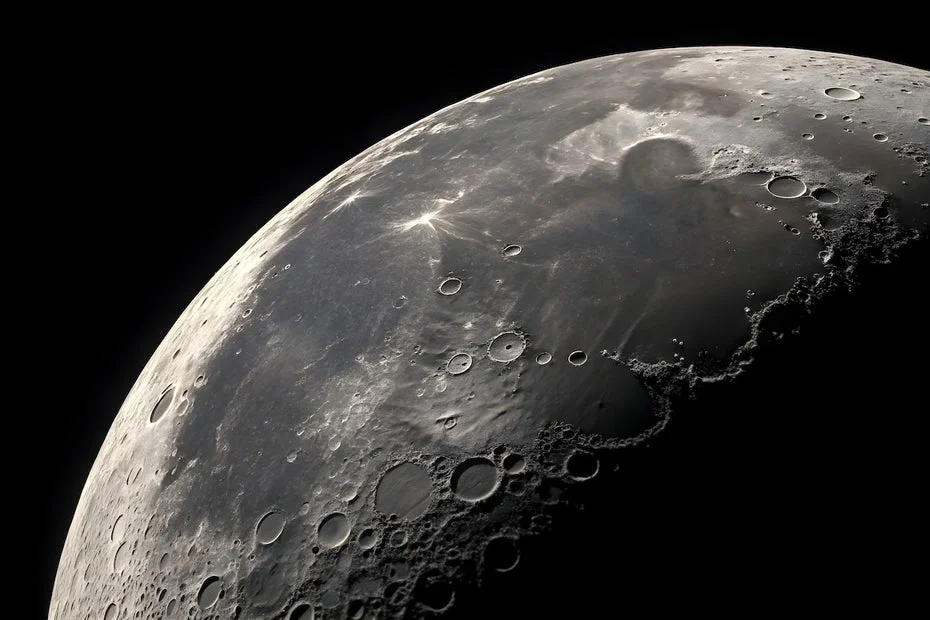
The Moon, formed approximately 4.5 billion years ago through a collision involving a precursor to Earth and a Mars-sized object, was initially a hot celestial body. Continuous bombardment by asteroids and meteorites, combined with the decay of radioactive elements, contributed to its early heat.
Over billions of years, the Moon has gradually cooled. This cooling process has led to a significant consequence: the Moon is shrinking. According to NASA, its diameter has decreased by about 50 meters over the last 100 million years, and this shrinkage is expected to continue.
The phenomenon of the Moon’s contraction is often likened to the transformation of a grape into a raisin. As the Moon shrinks, it develops numerous wrinkles and overlaps. However, unlike a raisin, the Moon's surface is brittle. As it contracts, the crust can fracture, leading to seismic activity.
Recent research published in The Planetary Science Journal indicates that the Moon is geologically more active than previously believed. This study utilized data from instruments deployed during the Apollo missions in the 1970s, which recorded a variety of shallow lunar quakes. The researchers also mapped relatively young tectonic structures, including lobate scarps—wrinkle-like faults found on the lunar highlands—and newly identified Small Mare Ridges (SMR) in the Moon's craters. Both structures are considered young in geological terms, being around 100 million years old.
The discovery of seismic activity in the Moon's lowland areas, known as the Mare, has significant implications for the upcoming Artemis missions. These missions aim to land astronauts in areas previously deemed safe. Artemis IV will mark humanity’s return to the Moon after more than 50 years, with astronauts set to explore the lunar south pole, where NASA hopes to find evidence of water ice.
However, recent findings suggest that the south pole region is heavily affected by tectonic activity, complicating what is already a challenging landing process.
Interestingly, lunar quakes last much longer than those on Earth, enduring for hours rather than just minutes. While they are less intense, with the most powerful recorded lunar quake measuring a 5 on the Richter scale, they can still disrupt sensitive equipment. This poses a challenge for NASA, as they must ensure that the Artemis missions are resilient against potential lunar quakes.