
The Fascinating Potential of Snail Slime: A Natural Model for Adhesives and Medical Coatings
Franziska Jehle from the Max Planck Institute explores the versatile properties of snail slime, which could inspire new adhesives and medical coatings.
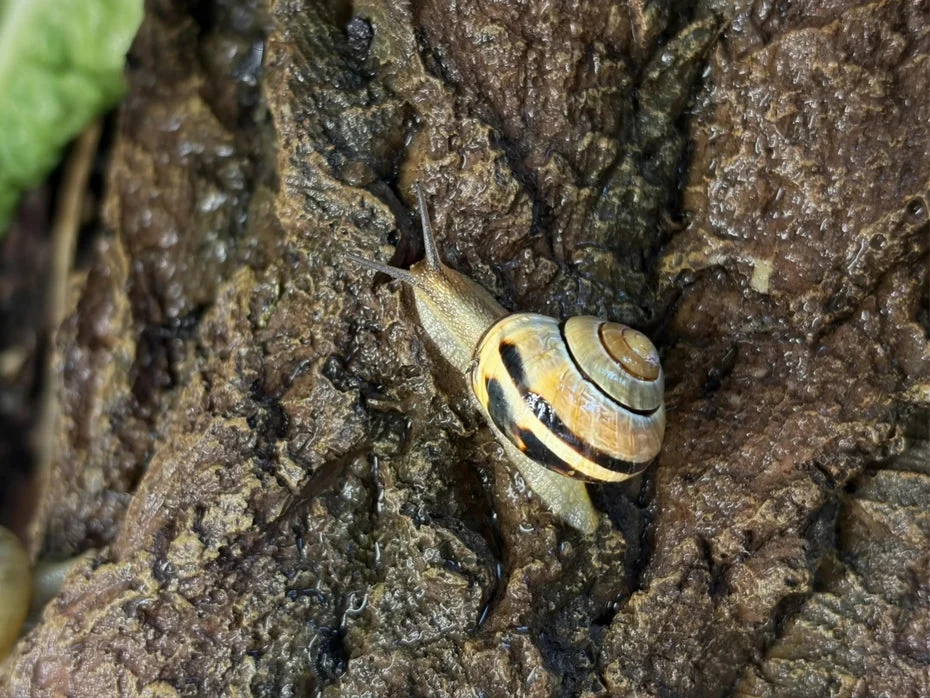
Many people find snails to be bothersome or even repulsive. However, Franziska Jehle, a researcher at the Max Planck Institute for Colloids and Interfaces in Potsdam, is quite enamored with them, particularly their viscous secretions. "Snail slime is an incredibly versatile material," Jehle states. This unique substance not only enables snails to glide across surfaces but also allows them to adhere to vertical structures, such as stems or walls. Additionally, it serves as protection against dehydration and injuries, effectively sealing their shells.
Jehle and her colleagues recently conducted an in-depth study on the common land snail, Cepaea nemoralis, which they detailed in the journal Science. The findings suggest that understanding the mechanics of snail slime could lead to the development of innovative adhesives and coatings for medical applications, according to co-author and institute director Peter Fratzl. "If we grasp the underlying principles, it will be crucial for creating sustainable materials," he emphasizes.
The research team discovered that snails produce various types of slime from the same fundamental ingredients: proteins, primarily fibrous collagens, and a calcium salt. "The ability of snails to modify the properties of their slime using the same building blocks makes them particularly intriguing for research," Jehle notes.
Five Types of Slime from Identical Ingredients
The researchers analyzed five distinct types of snail slime. One type, known as "gliding slime," is formed under the snail's mouth and on its foot. Under mechanical stress, this slime behaves like a liquid, while it exhibits nearly solid properties when at rest.
Another type, responsible for the snail's adhesive capability, is produced in the mantle, a layer within the shell. Additionally, two types of defensive slime are generated in the snail's mantle: a yellow, sticky, and highly resilient variant, and a bubble-infused slime, which is likely used to suffocate small predators or wash them away from the shell. The fifth type is used to seal the snail's shell, particularly during winter.
Structure of Snail Slime: Collagen Provides Framework, Calcium Connects
The team analyzed the proteins in various slime samples and examined structural details using X-ray fluorescence and diffraction measurements. All samples contained the same basic ingredients. Surprisingly, they found that "Collagen VI," which also plays a structural role in human skin, bones, and joints, is crucial in slime formation. The collagen content determines the density of the protein network, and consequently, the viscosity of the slime.
The arrangement of these molecules is influenced by calcium carbonate, commonly referred to as lime. This salt, composed of calcium and carbonate ions, is stored in the snail's glandular tissue. Calcium ions aid in cross-linking the proteins, making the slime overall more robust.
Snail-Inspired Adhesives
The adhesive properties of snail slime have intrigued researchers for years. In 2019, for instance, a team from the United States reported on a polymer gel inspired by snail slime that could support a person hanging by a band. However, this adhesive has yet to reach supermarket shelves and is not considered "bio" as it is a type of plastic.
"This research group employs a substance that behaves similarly to one of the snail slimes, but it fundamentally has nothing in common with the natural slime," Jehle explains. The adhesive effect of the natural slime arises from a highly complex, hierarchically structured material. "Replicating this structure is very challenging," the researcher adds. The same goes for other natural adhesives, such as the glue that mussels use to attach themselves to rocks and boats. "Therefore, synthetic adhesives have yet to match the performance of natural materials," Jehle concludes.