
The Hidden Cost of AI: Tech Industry Massively Acquires Gas Turbines
The massive energy demands of new data centers pose unsolvable challenges for infrastructure worldwide. To maintain operations, the tech industry is now resorting to a drastic and costly measure.
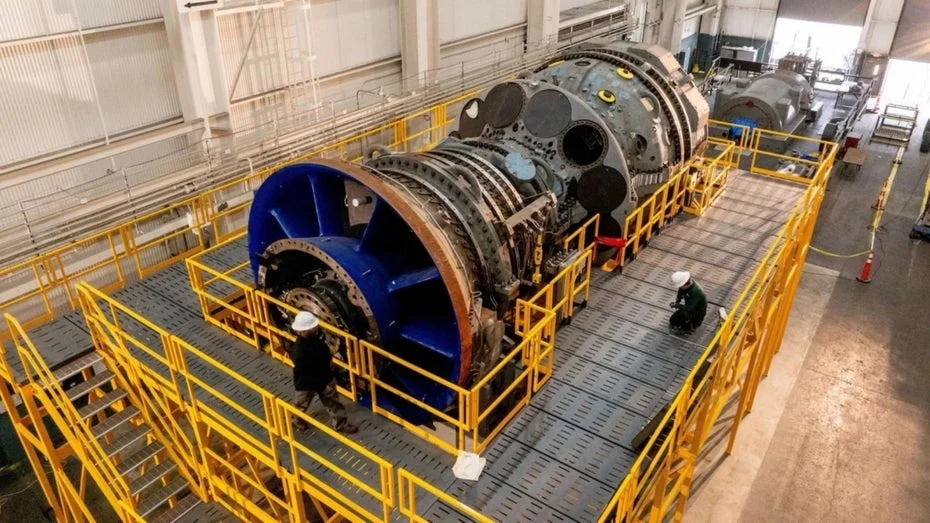
The rapid development in the field of Artificial Intelligence is leading to a massive expansion of data centers, whose energy demands are overwhelming existing power grids. To circumvent these bottlenecks, operators are now purchasing their own energy generation facilities on a large scale, as reported by the US news channel CNBC.
The focus is on massive industrial gas turbines, manufactured by established industrial companies as a reliable base load source. "When you need power on a large scale and also a secured base load, the industrial gas turbine is currently one of the leading solutions for that," explains Pablo Koziner, a senior manager at GE Vernova, which produces such facilities at its plant in Greenville, South Carolina.
Billion-Dollar Investments in Infrastructure
The sheer size of these machines illustrates the effort, as a single unit stands nearly 9.5 meters tall, weighs around 280 tons, and can theoretically supply energy to up to 500,000 households. The manufacturer's order books are already filled through 2029, with about 20 percent of current orders coming directly from data center operators.
This development is also driving costs up significantly, with the price for a single gas turbine having risen by 300 percent over the past three years to an estimated $250 million. The enormous demand from the tech industry is leading to a real boom in traditional heavy industry, which is reflected in the financial data of the manufacturer, who expects contractual agreements for a total capacity of 110 gigawatts by the end of 2026.
Prominent Projects Highlight the Need
Numerous well-known tech companies are currently investing billions in this independent power supply to secure their data centers for the operation of Artificial Intelligence. According to the report, Microsoft is equipping a planned data center in Texas with seven of these units, which are expected to deliver a total of 2.7 gigawatts of power.
The company xAI, led by Elon Musk, also utilizes such facilities in its data center in Tennessee, while OpenAI's Texas project Stargate calls for another gigawatt of power. The autonomous power supply through their own power plants proves to be the only solution for companies to avoid delays in the already sluggish expansion of public power grids.
Hybrid Systems to Bridge Gaps
To bridge the time until the turbines ramp up during a sudden power outage, engineers typically rely on hybrid systems. Large battery storage units are interposed to ensure a seamless power supply for the highly sensitive server landscapes.
These combined facilities allow data centers to operate as technological islands in emergencies, completely independent of the rest of the power grid. In practice, this results in huge industrial facilities being built right next to server farms, which, in addition to the enormous investment costs, also places high logistical demands on the locations.
The Conflict with Climate Goals
The direct reliance on fossil fuels stands in stark contrast to the ambitious climate goals that the industry has set for itself over the past decade. Although manufacturers argue that current turbines are twice as efficient as those from twenty years ago and are fundamentally prepared for future operation with hydrogen, the current use remains highly problematic.
Building their own gas power plants to supply Artificial Intelligence does solve the energy problems of data centers in the short term, but merely shifts the ecological challenges to another level. It remains to be seen how companies will justify this pragmatic balancing act between rapid technological growth and the necessary sustainability to the public in the long term.