Three Hours Underwater: How Researchers Upgrade Cockroaches to Cyborg Divers
When rescue teams cannot proceed in inaccessible areas, unconventional aids come into play. A new development from Asia equips tiny helpers for extreme conditions and overcomes physical limits. A team of researchers from Nanyang Technological University in Singapore and Waseda University in Tokyo has developed a flexible diving suit for cyborg insects.
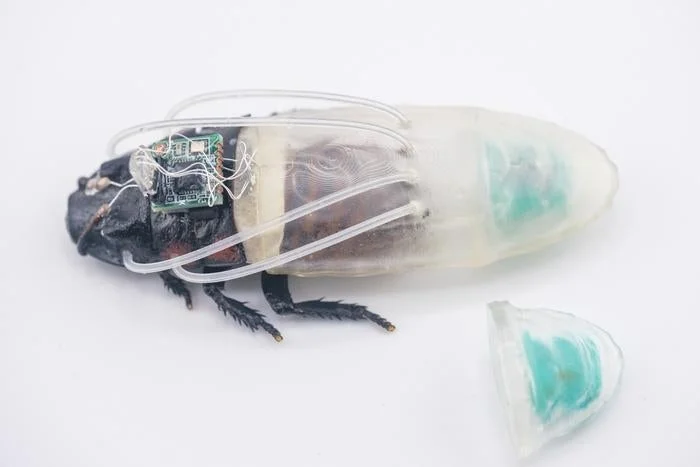
A team of researchers from Nanyang Technological University in Singapore and Waseda University in Tokyo, Japan, has developed a flexible diving suit for cyborg insects. This technology allows Madagascar hissing cockroaches to survive and navigate for up to three hours underwater or in oxygen-poor environments. As detailed in a study published in the British scientific journal Nature Communications, the development aims for use in disaster areas.
In such scenarios, flooded debris, deep puddles, or partially submerged tight spaces often block access for conventional rescue robots. Cyborg insects, meaning living animals with implanted electronic controllers for movement control, offer a significant advantage here because they use their own muscles for locomotion. This requires far less power than purely artificial miniature robots, whose drive motors typically drain their integrated batteries quickly.
Chemical Oxygen Tank Instead of Heavy Electronics
The main problem with previous cyborg insects is their absolute dependence on the natural respiratory system, which simply does not function underwater. Cockroaches breathe through tiny openings in their thorax and abdomen, known as spiracles, which ensure oxygen exchange with the air. Once the animals submerge, they can no longer extract oxygen from the water and suffocate within minutes.
To overcome this hurdle, the scientists constructed a compact, self-contained system that generates oxygen through a controlled chemical reaction. The diving suit consists of a 3D-printed oxygen generator, a waterproof casing, and flexible silicone tubes that direct the gas straight to the spiracles. The use of additional electronic components for oxygen production was deliberately avoided to keep the weight low and not burden the already small batteries of the control unit.
Successful Tests in Simulated Disaster Areas
Inside the tank, printed from transparent plastic, is a sponge coated with manganese dioxide as a catalyst. By adding a small amount of diluted hydrogen peroxide, a chemical reaction is initiated, causing the peroxide to slowly decompose and release oxygen along with a small amount of water. As reported by EurekAlert in a related announcement, the soft casing reliably protects the insects from the surrounding liquid. Lead researcher Hirotaka Sato categorizes this innovation as functioning exactly like the oxygen tank of human divers, ensuring a direct supply.
To demonstrate the practical performance, the research team sent the prepared cockroaches through a 1.7-meter-long test tunnel that simulated various danger zones. Initially, the animals had to cross a section filled with carbon dioxide, immediately followed by a tube completely flooded with water. Cockroaches without the suit lost their orientation in the gas mixture and suffocated in the water section within seconds. In contrast, the cyborg insects equipped with the oxygen generator successfully navigated both sectors at a steady pace.
Real Limits in Wet Environments
Despite these apparent technical achievements, the underwater trials also reveal significant physical limitations that must be considered in real-world applications. Underwater, the forward speed of the prepared cockroaches decreases by about ten percent compared to movement on land. The losses are even more pronounced during directional changes, as the animals respond to steering commands up to 51 percent slower due to the new technical structures.
This slowdown is primarily attributed to increased water resistance and the additional mass of the diving suit. Moreover, the natural buoyancy forces the insects to cling to the ground with their tiny claws to avoid losing balance or being swept away by currents. The mechanical effort required for this continuous grip significantly contributes to the physiological fatigue of the animals, noticeably reducing their agility in the wet environment over the duration of use.
Another critical point in practice is the unalterable time limitation of the system, as the chemical reaction is fully exhausted after a maximum of three hours. Once the hydrogen peroxide is depleted, the oxygen supply for the cockroach inevitably ceases. For prolonged search operations in extensive, confusing debris fields or sprawling sewer networks, this absolute time limitation must be factored into planning to prevent a total failure of the animal helpers.
In future development steps, the system is expected to be equipped with additional sensors and miniature cameras to provide actual reconnaissance data from disaster areas. Structural adaptations for other terrestrial insect species with comparable respiratory systems are also being worked on. However, before cyborg cockroaches can routinely search for survivors in massive floods, substantial technical hurdles regarding spatial navigation and the reliability of wireless data transmission from underwater need to be overcome.