
Challenges in AI Adoption: A Look at Germany's Struggles
A recent study highlights the challenges German companies face in fully leveraging AI technology, revealing that while many adopt AI, few are transforming their operations significantly.
Artificial intelligence (AI) is already enhancing productivity, driving growth, and shortening innovation cycles in German companies. However, a recent study warns that many businesses may miss the critical transition to the next generation of AI applications. Currently, 63% of companies are utilizing AI, but only a small fraction are advancing beyond basic tools like chatbots and copilot systems to develop new products and business models.
Limited Utilization of AI in Germany
While the adoption of AI is progressing rapidly in Germany, the economically vital leap remains elusive for most organizations. Only 15% of companies are employing AI comprehensively enough to generate new products, business models, or workflows, a decline from 21% the previous year. This figure places Germany below the European average of 22%, with many firms at risk of falling behind in the next stage of AI development.
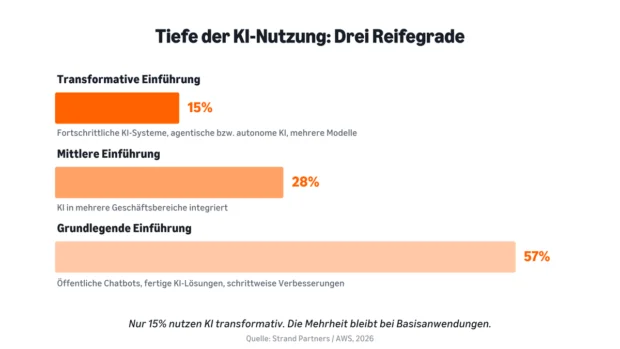
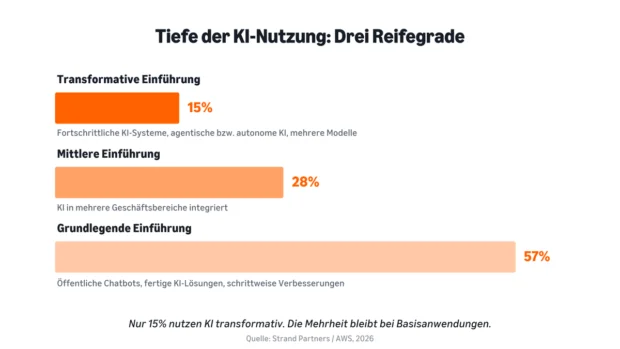
A closer examination of the maturity levels in AI usage reveals the underlying issue. A significant 57% of companies primarily use AI for basic applications, such as chatbots or standard solutions. Additionally, 28% have integrated AI into several business areas. However, truly transformative applications that lead to new products, services, or market approaches are only achieved by 15% of firms.
The Evolution of AI
AI technology is rapidly evolving. While many workplaces have adopted chatbots and copilot systems, emerging technologies like agentic AI, physical AI, robotics, and intelligent automation are now gaining prominence. Agentic AI can autonomously plan complex tasks, make decisions, and integrate various tools or data sources. Physical AI extends these capabilities to machinery and robotics, presenting significant opportunities for Germany's industrial sectors, including manufacturing and engineering.
Despite this potential, a gap remains. Only 22% of companies are familiar with agentic AI. However, after learning about the concept, 57% expressed interest in either implementing or exploring such systems. Even more concerning, only 16% of firms are aware of physical AI.
Benefits of Agentic AI
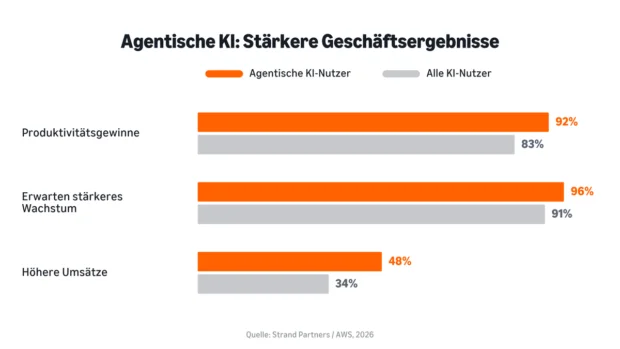
Currently, few organizations are productively utilizing agentic AI, but those that have taken the plunge report significantly better business outcomes compared to the average AI users. The study reveals the economic potential of this next generation of AI systems: 92% of companies using agentic AI report productivity gains, 96% anticipate additional growth, and 48% have seen increased revenues. They frequently cite faster decision-making and task execution (45%), greater operational efficiency (35%), and more scalable business processes (24%) as key benefits.
In contrast, the overall results from all companies employing AI—regardless of their level of advancement—indicate lower figures: 83% report productivity gains, 91% expect growth, and 34% have experienced revenue increases.
Barriers to Transformation
The study also identifies why many companies struggle to transition from initial AI applications to a comprehensive transformation. A lack of skills, investment, and favorable conditions are significant hurdles.
The most commonly cited barrier is the absence of AI and digital competencies, noted by 49% of companies. While nearly 20% believe they possess strong AI skills, the majority recognizes a substantial need for further training. Additionally, 39% lack a dedicated AI budget, despite 84% acknowledging that AI competencies will be crucial in their industry within the next five years.
Regulatory challenges further complicate the path to advancement. Approximately 44% of technology spending is currently allocated to compliance, with 82% of firms reporting an increase in these costs over the past three years. Many view this as an additional obstacle to adopting and scaling new AI applications.
Risk of Losing Innovative Startups
Germany is recognized as a strong hub for innovation, yet many AI startups are increasingly considering better growth opportunities outside Europe. The study's authors caution that while Germany is home to innovative companies, future growth, investment, and value creation may shift to other regions.
The root of the issue lies less in the absence of ideas and more in the surrounding conditions. To transform AI into new products, business models, or globally successful companies, access to capital, skilled professionals, international markets, and reliable regulations is essential. Many founders believe that other countries offer more favorable circumstances.
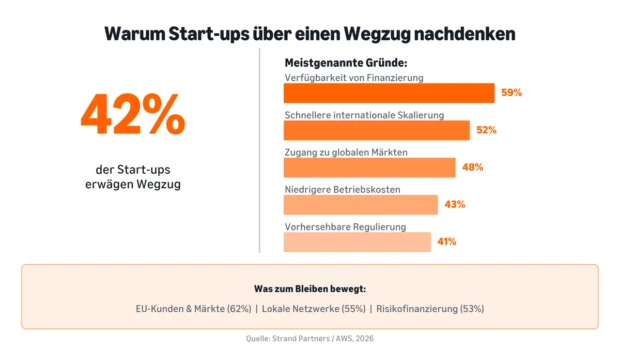
A striking 42% of German AI startups are contemplating leaving Europe to scale more rapidly. The primary reasons include better access to funding (59%), quicker international scaling (52%), access to global markets (48%), lower operational costs (43%), and more predictable regulations (41%).
Factors to Retain Startups in Europe
The study also highlights factors that could encourage startups to remain in Europe. Key considerations include good access to European customers and markets (62%), robust networks of companies, universities, and accelerators (55%), and sufficient risk and growth financing (53%).
The competition among locations is becoming increasingly significant. In light of the growing reliance on major US tech firms and political decisions in the US, Europe is striving to become more attractive for AI companies. This includes not only providing better growth conditions for local startups but also attracting leading international AI firms to the region. Austria's recent initiative to bring Anthropic to Europe serves as a case in point.
The Future of AI in Germany
Overall, the study presents a nuanced picture. Germany is now among the leading AI hubs in Europe regarding adoption. However, the extent to which the country can capitalize on AI's economic benefits remains uncertain.
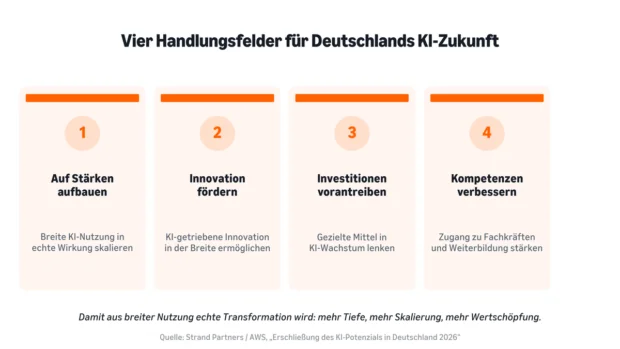
The future of Germany's role in the next wave of AI will depend on whether companies view AI not just as a tool but as a means to develop new products, business models, and value creation. Achieving this requires skilled professionals, capital, and political frameworks that not only foster innovation but also retain and attract businesses, investments, and value creation in Germany and Europe.