
New Findings Reveal the Milky Way is Larger Than Previously Thought
New research reveals that the Milky Way's outer spiral arms are significantly farther from the galactic center than previously thought, prompting a reevaluation of our understanding of the galaxy's mass and structure.
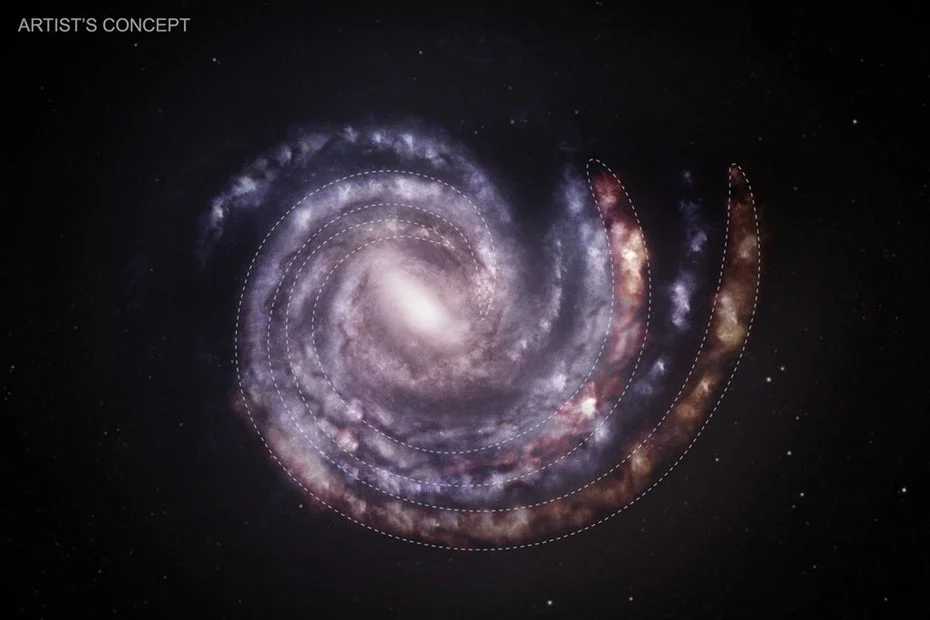
Recent research has uncovered that the outer spiral arms of the Milky Way, specifically the Outer Arm and the Outer Scutum-Centaurus Arm, are approximately ten percent farther from the galactic center than previously estimated. This unexpected revelation comes from a team led by Beatrice Vaia from the Italian Scuola Universitaria Superiore IUSS Pavia, as detailed in a study published in the journal Astronomy & Astrophysics.

The researchers employed an innovative approach to examine the edges of our galaxy. Their findings not only indicate a significant shift in distance measurements but also reveal that the most distant galactic arm has an impressive thickness of around 3,500 light-years.
Limitations of Traditional Models
Historically, astronomers relied on kinematic models to map the vast expanse of the Milky Way, which were based on observations of gas clouds and their radial velocities. However, being situated within our own solar system often obstructs direct visibility to these distant structures due to dense interstellar dust.
To overcome this challenge, scientists traditionally utilized complex rotational models to infer the actual spatial distances of the spiral arms from the observed motion data. Unfortunately, these indirect calculations have proven increasingly error-prone and inaccurate over vast distances in the galaxy's outer regions.
Using Light Echoes as a Cosmic Measuring Tool
To obtain more accurate measurements of these colossal dimensions, the researchers implemented an unconventional method grounded in pure geometry. They harnessed the extremely bright X-ray radiation from extragalactic gamma-ray bursts, which reflects off dust clouds within the galactic spiral arms and is registered on Earth as a light echo.
These continuously expanding rings of X-ray dust scattering behave similarly to acoustic echolocation signals underwater, enabling the researchers to achieve precise distance measurements. This innovative technique eliminates uncertain assumptions about galactic rotation, relying solely on the timing and angle of incoming radiation.
Reanalyzing Decades of Data
For their comprehensive analysis, the researchers utilized historical measurement data from specialized instruments such as NASA's Chandra X-ray Observatory. They also incorporated long-term observations from the European Space Agency's XMM-Newton Observatory.
The strategic combination of these diverse datasets, including exceptional recordings of the bright gamma-ray burst GRB 221009A, allowed the team to accurately calculate distances to distant dust structures. Their final measurements extended to an astonishing 19 kiloparsecs, equivalent to about 62,000 light-years.
Implications for Galactic Mass
While the newly identified discrepancies in measurement models may seem minor at ten percent, they hold significant implications for our fundamental understanding of the Milky Way. According to co-author Ilaria Fornasiero, these corrections necessitate a reevaluation of previous estimates regarding the galaxy's total mass.
This altered mass distribution will directly influence theoretical models explaining how the spiral arms have formed and evolved over millions of years. Consequently, the scientific community anticipates that these fresh insights will profoundly impact existing models of galactic evolution in the years to come.
Challenges of the Innovative Method
Despite the elegance of this geometric measurement technique, it faces a critical limitation that currently prevents a comprehensive remapping of the entire Milky Way. Extragalactic gamma-ray bursts occur unpredictably in the universe and must also fortuitously pass through suitable dense dust clouds within our galaxy for precise measurements.
"We rely on the universe to provide us with these events, and in over 25 years, we have found only a handful that we can use," explained co-author Andrea Tiengo, highlighting the immense challenges in systematic data collection. Thus, astronomy remains dependent on rare occurrences to accurately measure more pieces of our galactic puzzle in the future.