
This Planet Should Have Burned Up Long Ago – Researchers Now Have an Explanation
This planet shouldn't exist. WD 1856 b orbits closely around a white dwarf, despite having to burn up during its star's red giant phase. Since its discovery in 2020, WD 1856 b has puzzled scientists.
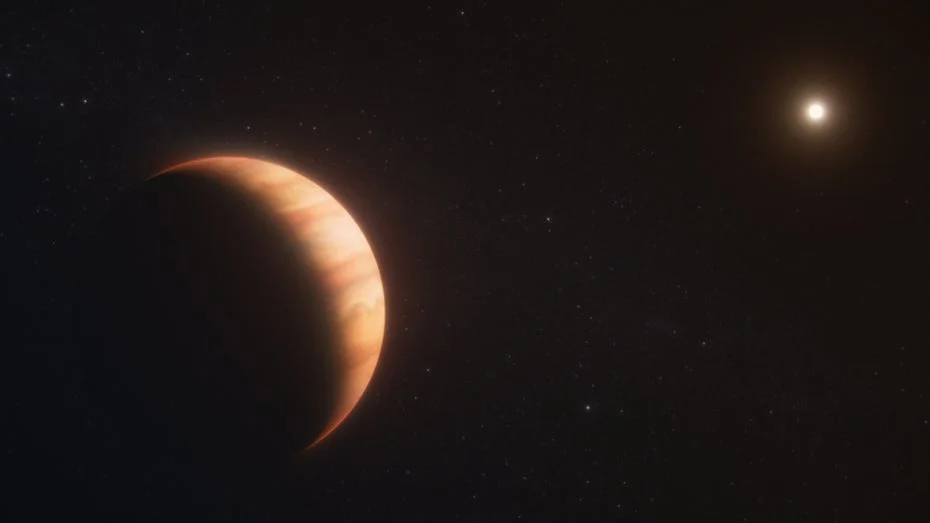
Since its discovery in 2020, WD 1856 b has puzzled scientists. The exoplanet orbits its star WD 1856, located 80 light-years away from Earth. WD stands for White Dwarf.
The planet is a gas giant approximately the size of Jupiter. Its mass is about 14 times that of Jupiter, according to NASA. Its star, on the other hand, is a white dwarf, roughly the size of our Earth.
How Did the Planet Survive the Red Giant Phase of Its Star?
The strange thing about WD 1856 b: The gas giant moves in a very tight orbit around its significantly smaller star. It takes 60 times less time to complete an orbit than Mercury, the closest planet to the Sun in our system.
The question has been how such a nearby planet could survive the red giant phase of its star. When stars the size of WD 1856 exhaust their energy for nuclear fusion, they first transform into a red giant. Nearby planets would burn up during this phase. Only afterward does a star become a white dwarf.
Does WD 1856 b Come from a Distant Orbit?
An international research team led by Cornell University in New York has now found an explanation. The scientists observed and studied WD 1856 b with the James Webb Space Telescope during a transit around its star. They published the results of their research in the journal Nature.
The researchers considered two hypotheses. Either the planet must have survived the red giant state, or it only entered the orbit of WD 1856 when it was already a white dwarf.
Too Hot to Be Heated by a White Dwarf
The research team examined the temperature of the planet and found that it is too hot to be warmed by a white dwarf. Therefore, it must have been heated somewhere else beforehand.
The researchers discovered that WD 1856 b must have heated up between 3 and 5.5 billion years after the star transformed into a white dwarf. During its time as a red giant, it was far enough away to survive.
WD 1856 b is part of a triple star system. The two other stars could have influenced the orbit of this giant planet, according to the scientists. As it approached the white dwarf, it could have heated up, as stated in a press release from Cornell University.
Implications for the Future of Our Solar System
The study of WD 1856 b and its gigantic companion could provide insights into the future of our solar system. For our Sun will also eventually evolve into a red giant and then a white dwarf, although not for billions of years.
Current research suggests that Mercury and Venus will be destroyed by the Sun as a red giant. The fate of Earth and the more distant gas planets remains unclear. The study conveys that planets can still wander within the influence of their star even after its death.