Google Hides Opening Hours Behind AI Tips – And You Can't Turn It Off
Google Gemini provides unsolicited food recommendations, raising concerns about the influence of AI on user experience and content accessibility.

“My tip: The sushi surprise platter,” this recommendation comes from Google Gemini. Why is an AI, which cannot have taste, unsolicitedly suggesting what I should order? Since June, I have been annoyed by "helpful hints" while searching for restaurants on Google Maps, which really do not deserve that name.
Opaque AI Summaries Are Not Helpful
For various eateries in Hanover, I am shown whether the outdoor area might be a bit chilly – which is truly surprising, as no one would think of that – whether I should make a reservation, or which dish supposedly tastes good according to the AI.
Gemini makes these suggestions based on user reviews from the past twelve months. The AI analyzes the reviews and creates "a helpful summary of the general sentiment," according to the explanation of the Gemini texts. They are not available everywhere: If there are not enough reviews or if the AI does not find sufficient repetitions, users are spared.
For me, it is thus opaque what leads to the three short bullet points that stick at the top of the info overview in Google Maps. Relevant information, such as opening hours and website, is brazenly pushed further down by Google.
Gemini Is Not My Friend
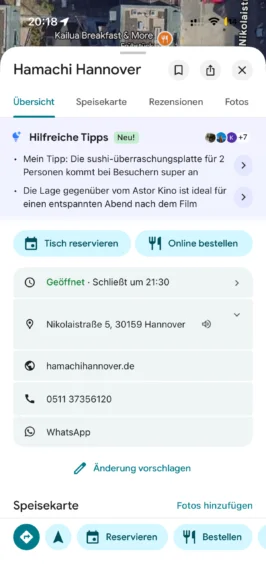
The AI tips are at the top, while information like opening hours and website are now below. (Screenshot: Google Maps)
Moreover, Gemini presumes to give an unsolicited personal tip about food. The tips are sometimes phrased as if a friend were recommending her favorite dish to me. This bothers me. Google technically creates a closeness that is misleading.
Gemini cannot tell me what tastes good, because AI has no taste. Gemini cannot feel cold, because AI has no sense of temperature. In this personal area, it all comes down to what AI cannot do and does not have: feelings and personality. And this content is appropriated by AI uninvited.
Even without AI, Google could have made reviews more accessible, for example, through a better search function. Alternatively, the company could provide statistical evaluations that are formulated factually rather than personally, making them easier to understand.
Is This the Path to an Agentic AI Dystopia?
For me, this small example shows how Google is gaining more power over content. We users are being trained to be satisfied with the AI-generated summary. The sources behind it require more clicks and thus more effort. And even there, I only see a small excerpt.
I wonder where this leads. Is this preparation for a day when only agents will communicate? Will my chosen AI tool then store my eating habits, compare them with automatically generated reviews from other AI agents, and find me a place and dishes? Will my AI agent ask me after every meal how it was? Will I then only eat the “sushi surprise platter”? Unfortunately, I do not know the answers to these questions. To me, it sounds like a dystopia that hopefully will not come to pass.
What I want to know right now: How do I get rid of these useless “helpful information”? I have not yet found the setting to deliberately turn off this disturbance. Helpful tips from people can reach me at [email protected].