
These Mini Reactors from the Assembly Line Aim to Meet Rising Electricity Demand
Explore how small modular reactors (SMRs) are designed to meet the rising electricity demand driven by data centers and air conditioning systems, and learn about their innovative technology.
- Home
- News
- Future & Science
MIT Technology Review
Don’t miss any news anymore!
Due to the immense energy demand from data centers and air conditioning systems, nuclear reactors are regaining popularity worldwide. Small modular reactors are designed to make nuclear energy suitable for mass production and flexible. Our graphics explain how they work.
By Casey Crownhart
Every nuclear power plant built today is customized and designed for a specific location. Commercial nuclear reactors all operate on the same principle: atoms of a radioactive material split and release neutrons. These neutrons collide with other atoms, split them, and cause them to emit more neutrons, which in turn collide with other atoms. This creates a chain reaction. This reaction releases heat, which can be used directly or helps convert water into steam. The steam drives a turbine that generates electricity.
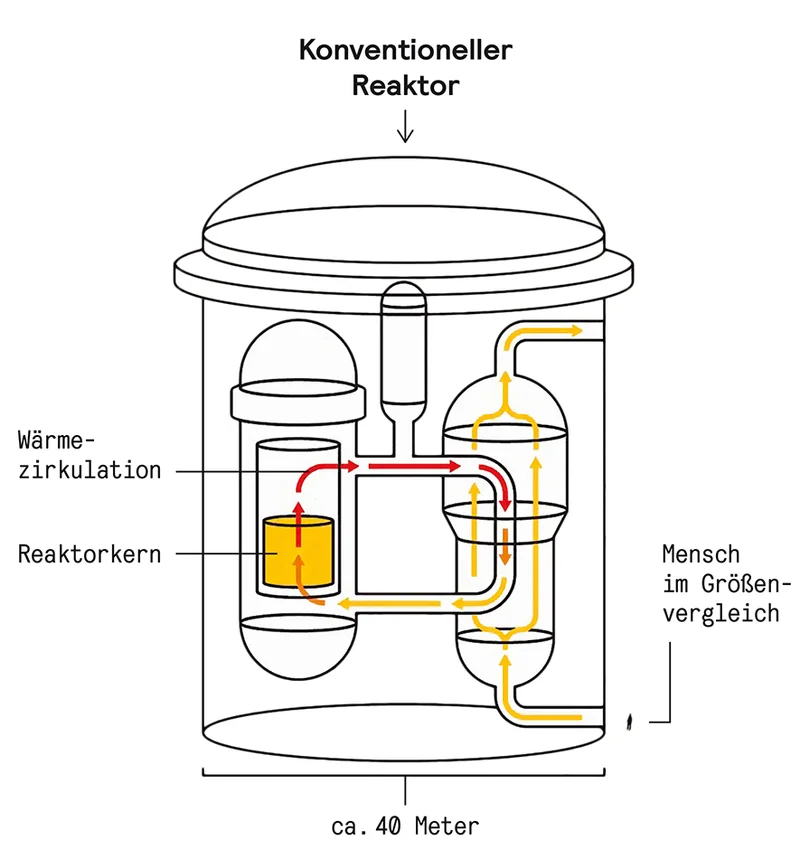
The schematic structure of a conventional reactor. (Graphic: Matthias Timm / MIT Technology Review)
Small Modular Reactors – Reactors in Reduced Size
Small modular reactors (SMRs) aim to bring standardization, assembly line manufacturing, and thus lower costs to the development of nuclear reactors. Experts still expect costly adjustments to site-specific conditions. The question of where to store the resulting nuclear waste is also still unresolved.
- The US company BWXT is developing SMR reactors with the US Department of Defense for military bases, mines, or remote communities that need power after a disaster.
- A chemical company is planning small reactors for heat generation in collaboration with the nuclear startup X-energy.
- In the USA, Kairos Power received approval to build the small demonstration reactor Hermes 2, which is expected to be operational by 2030.
- The first startup developing new nuclear reactors has successfully brought its reactor to a critical state.
- Two SMR plants are already operational in China and Russia.
- In China, the demo project Linglong One is under construction at a site with two large reactors.
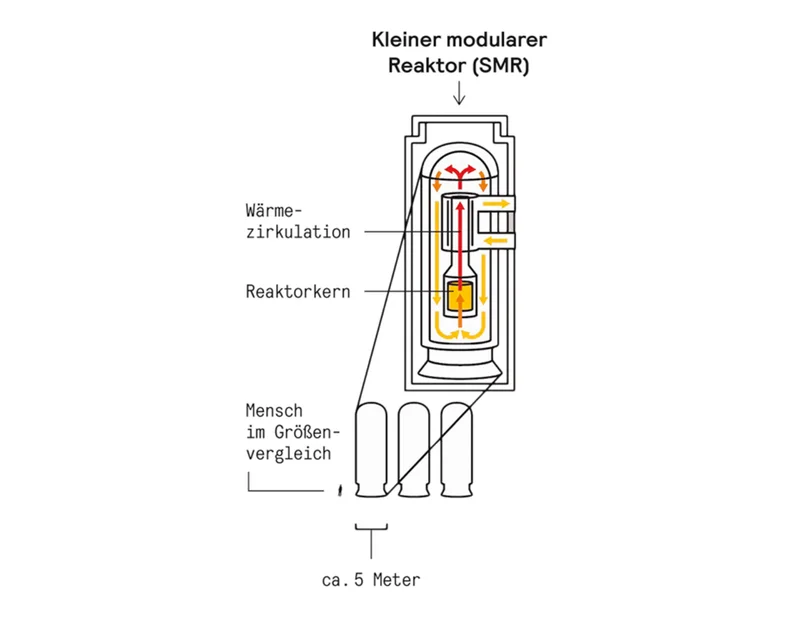
Schematic representation of a small modular reactor. (Graphic: Matthias Timm / MIT Technology Review)
Fuel Supply
Reactor fuels based on uranium typically require three to five percent of the fissile isotope uranium-235. SMRs operate with more highly enriched fuel containing up to 20 percent uranium-235. The “High-Assay Low-Enriched Uranium” (HALEU) used in them can sustain a chain reaction longer before the reactor needs to be refueled.
In many SMR architectures, HALEU is processed into TRi-structural isotopic fuel (TRISO). TRISO consists of uranium particles with diameters of less than a millimeter, coated with carbon and ceramic. They encapsulate the uranium and its fission products.
TRISO is structurally more resistant to neutron irradiation, corrosion, oxidation, and high temperatures than conventional reactor fuels.
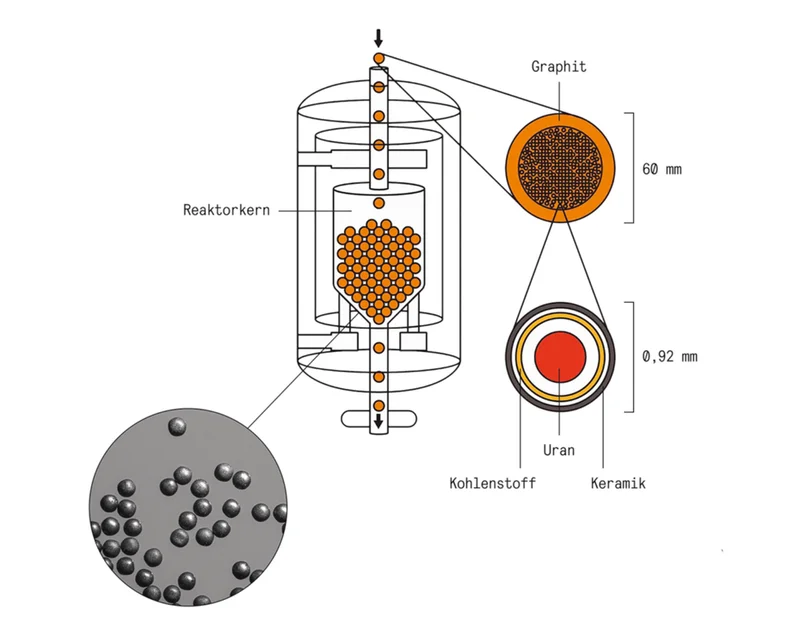
The uranium-containing particles are embedded in cylindrical or spherical graphite pellets. The fission reaction occurs within the pellets, but the heat can escape. (Graphic: Matthias Timm / MIT Technology Review)
Heat Transport
The coolant in the reactor not only conducts the heat from the fission reaction but also controls the chain reaction. Conventional reactors use water for this purpose. In pressurized water reactors, it is under extremely high pressure at temperatures up to 300 degrees Celsius.
In the new generation, especially liquid metals, molten salt, or gas are to be used. These coolants can be heated to up to 1000 degrees Celsius and thus transport more heat than water.
Metal or salt remains liquid at high temperatures, and reinforced high-pressure safety casings are not required for the reactors.
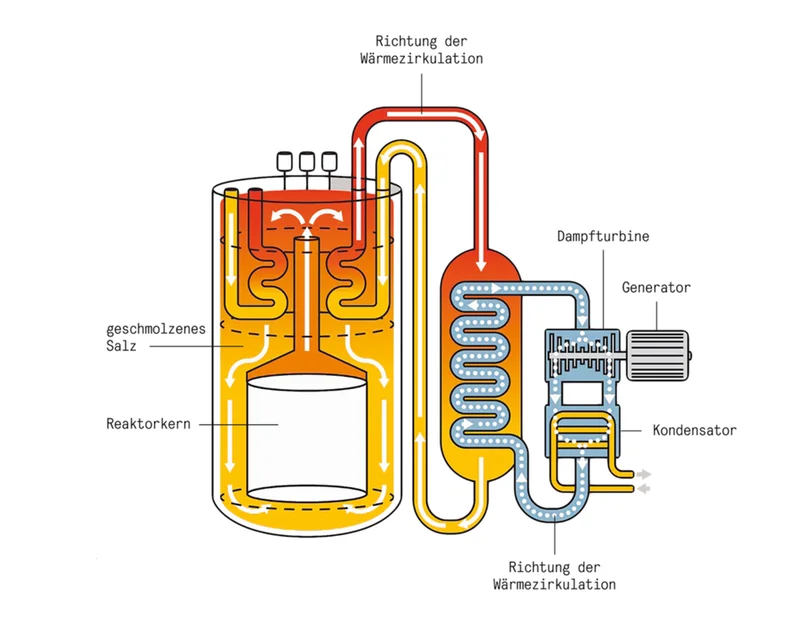
Schematic representation of heat transport in an SMR. (Graphic: Matthias Timm / MIT Technology Review)
They absorb heat from the reactor core and reach temperatures of about 650 degrees Celsius (red). This converts water (blue) into steam. After the salt or metal has cooled to 550 degrees Celsius (yellow), the cycle begins anew.
However, molten salt is corrosive in the presence of oxygen and imposes high demands on the materials in the cooling system. Sodium metal reacts explosively upon contact with water and requires a special safety casing.