
Researchers Weigh Invisible Black Hole – As Heavy As 6 Billion Suns
An international research team has gained an unexpected glimpse into the deep cosmic past, potentially changing our understanding of galaxy development.
- Home
- News
- Future & Science
Don't miss any news!
An international research team has gained an unexpected glimpse into the deep cosmic past. These observations could fundamentally change our understanding of galaxy development in the future.
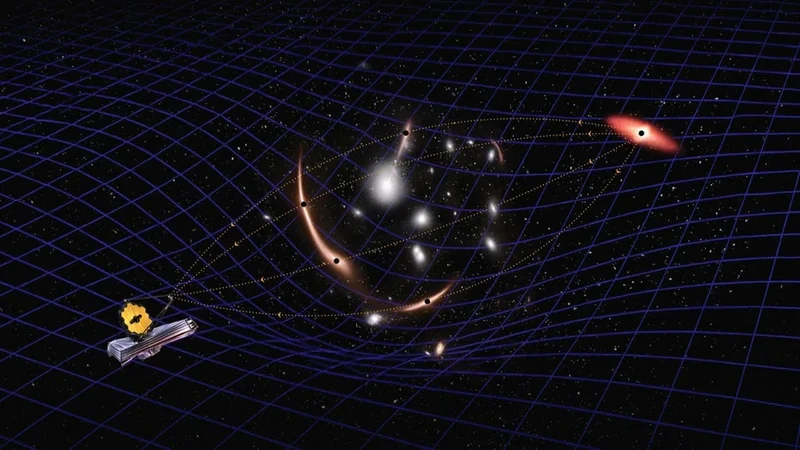
The James Webb Space Telescope has measured the mass of an inactive supermassive black hole at the center of the galaxy MRG-M0138. As reported in a study published in the journal Science, this galaxy is located more than ten billion light-years from Earth.
The object studied has a mass equivalent to about six billion solar masses. An international research team led by Andrew Newman from the US research institution Carnegie Science in Pasadena, California, which includes astronomer Mariska Kriek from the Dutch University of Leiden, observed the galaxy at a time when the universe was only about three billion years old.
A Look Through the Cosmic Magnifying Glass
Inactive black holes do not consume matter and therefore do not shine, making their direct observation extremely difficult. To determine the mass, researchers analyze the velocity of surrounding stars, a method known in astronomy as stellar dynamics.
So far, this method has only worked at a relative proximity of up to 700 million light-years from Earth. For the enormous distance to MRG-M0138, the team utilized the effect of gravitational lensing, where a foreground galaxy cluster focuses and magnifies the light thirtyfold.
Challenges and Limits of Observation
Although the measurement represents a breakthrough in astronomical observation, the collected data comes with certain uncertainties. The precise modeling of gravitational lensing is complex, and even the smallest deviations in assumptions can distort the calculated mass of the black hole.
Additionally, the scientists found that no new stars are currently forming in the galaxy MRG-M0138. According to co-author Richard Ellis from University College London, researchers can now "conduct a more comprehensive inventory of black hole development over time" to better understand their influence on galaxy evolution.
The researchers hope to soon discover more inactive black holes at similarly great distances. The James Webb Space Telescope will continue to play a central role in this endeavor. However, it should be noted that analyzing the complex image data remains extremely time-consuming and prone to errors.
This article was originally published on June 9, 2026, but it still interests many of our readers. Therefore, we have updated it and made it available again.

Top Articles