Cacio e Pepe Without Clumps: Physicists Reveal the Perfect Pasta Recipe
The Roman pasta dish "Cacio e pepe" contains, besides the pasta—preferably Tonnarelli—only three ingredients: pasta water, Pecorino Romano cheese, and pepper for seasoning. However, preparing this dish for many people proved difficult, as a team of physicists discovered.
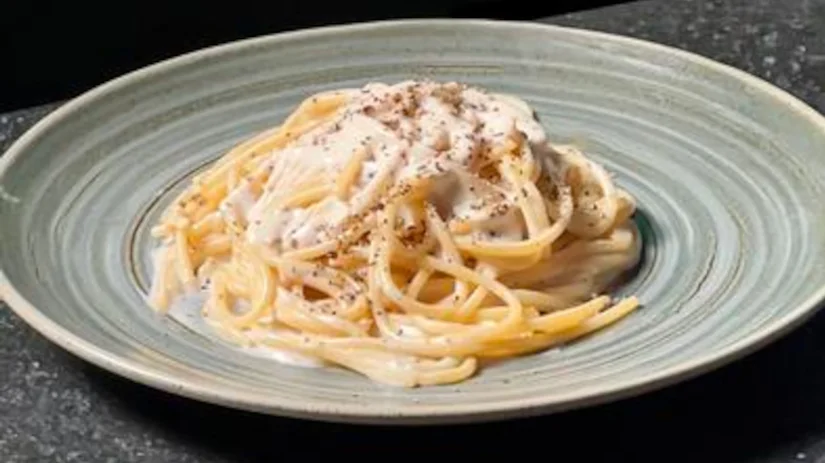
The Roman pasta dish known as "Cacio e pepe" contains, besides the pasta—preferably Tonnarelli—only three ingredients: pasta water, Pecorino Romano cheese, and pepper for seasoning. However, preparing this dish for many people proved difficult, as a team of physicists, all Italians, discovered. In the worst case, a thick clump of cheese formed at the bottom of the pot. But the dish actually calls for a creamy sauce. Since the right preparation involved preventing phase separation, the physical knowledge of the experts was required. This led to a research paper published in the journal "Physics of Fluids," which not only brings a tasty meal to the table but also helps to better understand the complex process of emulsion formation, like that of the sauce. The findings could also improve the manufacturing process of other foods. In the meantime, the researchers initially received the Ig Nobel Prize, awarded each year to studies and scientists whose seemingly absurd research is meant to first "make you laugh and then make you think," as stated in the prize's self-description. Physicist Fabrizio Olmeda from the Institute of Science and Technology Austria (ISTA), who was involved in the research, provides insight into the delicious investigation.
MIT Technology Review (TR): Congratulations on the Ig Nobel Prize. Was the award a surprise for you and your team?
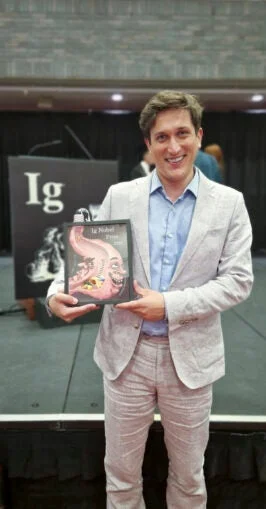
Ig Nobel Prize winner Fabrizio Olmeda with the award. (Photo: ISTA)
Fabrizio Olmeda: Thank you! To be honest, because our research had such a fun approach, we joked about it from the very beginning and even hoped for the Ig Nobel Prize. Still, we were all very excited when we received the news. And we were quite surprised by how much media attention the topic received. I hope that my regular research—focused on the physics of single-cell genomics—will also attract such attention one day. It has potential applications for a better understanding of tissue development and regeneration.
It's one of my favorite dishes, but I would wait a while before eating it again.
TR: How much pasta did you have to eat to find the right recipe? And by the way, do you still like the dish?
Olmeda: Don’t remind me! (laughs) But joking aside: The experiments and quantifications were conducted solely with the sauce, which we placed on Petri dishes. So, no pasta, but a lot of Pecorino cheese! Then we collected all the samples and invited friends over for dinner. One of us mentioned that his recent blood tests were not particularly good due to the experiment—so you could say we really sacrificed ourselves for science. After the publication, of course, each of us was asked to cook Cacio e Pepe multiple times. It’s one of my favorite dishes, but I would wait a while before eating it again. (laughs again)
TR: How did you come up with the idea to investigate the behavior of the soft matter, this sauce?
Olmeda: As Italian physicists living abroad, it was clear to us to spend time together, sit at a table, eat traditional Italian dishes, and talk about physics. Cooking for many people was never a problem, except when it came to "Cacio e Pepe." With larger quantities, the sauce often became clumpy because the heat was difficult to control. This became a recurring theme for us: How can you consistently prepare Cacio e Pepe for a large group without errors?
The clumps looked to us like a case of phase separation—a field some of us had already been working on. So, of course, we connected this problem with our scientific expertise during dinner.
TR: The result of the study is that you need the right amount of starch in the sauce. How did you figure this aspect out?
Olmeda: I believe that at first, we underestimated the role of starch. It was known that starch is important since you usually use pasta water to prepare the sauce, which contains starch. So, starch is a hidden ingredient in Cacio e Pepe. However, we quickly found out that the starch in the pasta water was not enough. To find the right combination, of course, further experiments were necessary, where all other parameters, such as the ratio of water to cheese, were varied.
My mother often cooked it, and now she has also tried our scientific recipe with great success!
TR: How did other colleagues react when they found out you were researching this pasta sauce and cooking it for tasting?
Olmeda: In the months following the submission of the preprint (arxiv) and the publication, we really had to cook the dish often. To add to what I said earlier: I think it was a good opportunity to spend a nice time with our friends. Food is something that brings people together.
TR: One more personal question: How did your parents react to your research and the award?
Olmeda: I am actually the only one from Rome—the city from which Cacio e Pepe originally comes—in the group. Therefore, I have eaten a lot of Cacio e Pepe in my life. My mother often cooked it, and now she has also tried our scientific recipe with great success! My parents were both very happy for me—just like all my friends—after they saw the news. However, I had to explain the concept of the Ig Nobel Prize to them, which, if you don’t know it, might sound strange at first.
Der Artikel wurde ursprünglich am 25.09.2026 veröffentlicht, interessiert jedoch immer noch sehr viele unserer Leser:innen. Deshalb haben wir ihn aktualisiert und hier nochmals zur Verfügung gestellt.