
Salt Clouds in Space: James Webb Telescope Solves Mystery of the 'Pink Planet'
A strange celestial body in distant space has posed complex puzzles for science for over a decade. Using cutting-edge infrared technology, surprising atmospheric conditions are now revealed. The James Webb Space Telescope has analyzed the atmosphere of the celestial body GJ 504b in detail.
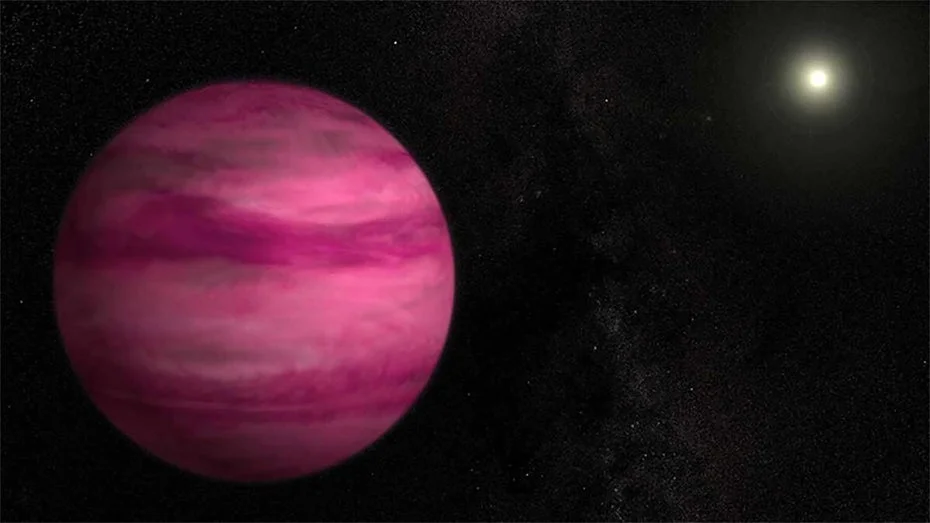
The James Webb Space Telescope has conducted a detailed analysis of the atmosphere of the celestial body GJ 504b, located about 57 light-years from Earth. A team of scientists led by astronomer Aneesh Baburaj from Northwestern University in the United States has detected deep-seated salt clouds.
These findings have now been published in a study in the prestigious journal The Astronomical Journal. The new data and analyses solve a physical puzzle that astronomers have been grappling with since the first direct observation of the object in 2013.
A Boundary Walker Between Worlds
GJ 504b glows in a magenta hue due to its residual thermal radiation, earning it the popular nickname "Pink Planet." With a mass nearly 25 times that of Jupiter, the object is so massive that its exact astrophysical classification has remained unclear.
It is considered a so-called planetary-mass companion, theoretically positioned right on the boundary between a massive gas giant and a brown dwarf. The latter are regarded in astronomy as failed stars that lacked the necessary mass at their formation to ignite sustained nuclear fusion in their cores.
The surface temperature of GJ 504b is a relatively cool 290 degrees Celsius. This relative coolness is a result of its advanced age, estimated in the current study to be between 2.5 to 4 billion years.
The Precise View Through the Infrared Eye
For previous ground-based telescopes, the celestial body was simply too dark due to its low temperature. Only the highly sensitive instruments of the James Webb Space Telescope have now enabled a direct spectroscopic examination of the object.
The astronomers used the onboard infrared spectrograph called NIRSpec to isolate the faint light of the companion from the extremely bright light of its parent star. They employed complex image processing techniques, combining images taken from slightly different angles to computationally eliminate the star's noise signals.
Subsequently, they decomposed the remaining radiation into its individual wavelengths to decipher the chemical fingerprint of the gas envelope. The team found clear signals of a whole range of complex molecules. In addition to carbon dioxide, water, methane, and ammonia, the sensitive technology also detected hydrogen sulfide and various forms of carbon monoxide.
Computer Simulations Bring Clarity
However, the signals measured in the raw spectroscopic data initially did not make physical sense in the abstract computer models. The radiation from the molecules deep in the atmosphere appeared measurably dampened, which should not be the case in a completely clear and cloud-free gas envelope.
The solution to this logical problem only came with the integration of a specific cloud layer into the simulation. While clouds on Earth consist of liquid water and on extremely hot gas giants of molten rock, GJ 504b has precisely the right temperatures for crystallizing salts.
The abstract computer models only matched the real measurement data from the telescope without error when the researchers considered clouds of condensed potassium chloride and zinc sulfide. Only this dense salt layer logically and coherently explained the blockage of deeper radiation in the measurements.
Concrete Clues About the Formation History
The spectroscopic data also provided scientists with fundamental insights into the general chemical composition of the atmosphere. The team found that the gas envelope is unusually enriched with elements that are heavier and more massive than hydrogen and helium.
In direct comparison to its parent star, the gas envelope of GJ 504b has about 2.5 times higher concentrations of carbon and double the amount of oxygen. Such heavy elements suggest, according to common models, a classic planet formation process, where the growing object continuously accumulates solids from a rotating dust disk around the star.
A brown dwarf, on the other hand, would emerge directly from the gravitational collapse of a pure gas cloud and would ultimately exhibit a much more star-like chemical signature. Nevertheless, the scientists critically point out that the current observations cannot absolutely rule out the brown dwarf theory, as the fundamental chemical data basis regarding the aging parent star still carries uncertainties.