
Astrophysical Models Challenged by Two Decades of Blazar Observations
A long-term analysis of the blazar PKS 2155–304 over two decades reveals discrepancies that challenge established astrophysical models, suggesting complex physical processes at play.
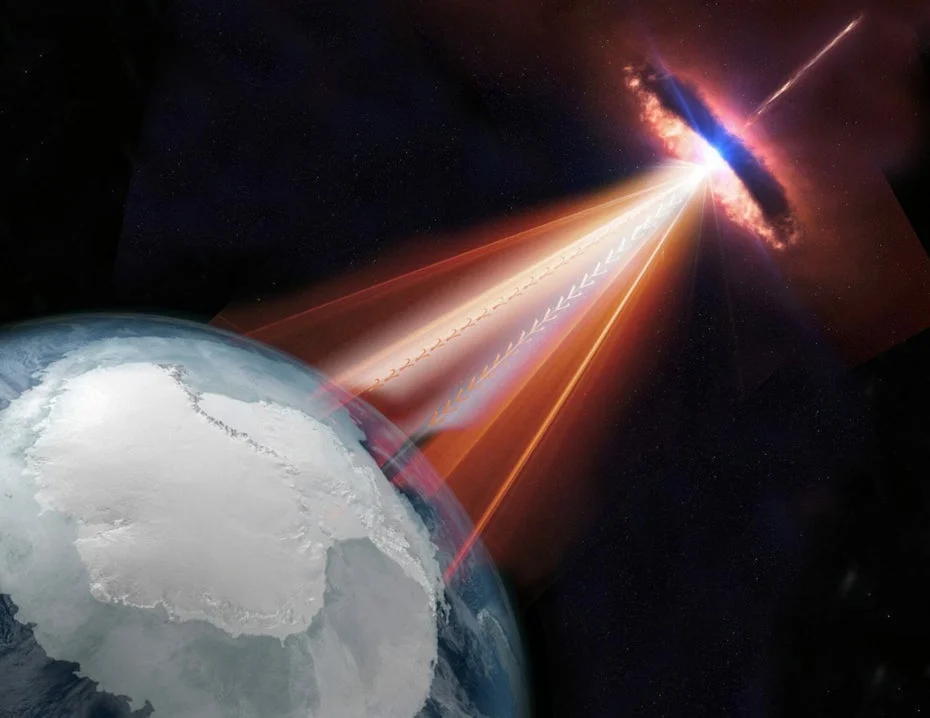
Blazars, some of the universe's most enigmatic and elusive phenomena, exhibit dynamic and unpredictable behavior. These distant galaxies emit incredibly narrow jets of luminous matter with astonishing force, often directed almost directly at Earth.
Traditionally, researchers have explained the characteristic flickering of this high-energy radiation using theoretical models based on short observation periods, often just a few days. However, a thorough examination of such a colossal astronomical object over a span of two decades has led to a collapse of these established astrophysical models.
The Downfall of Blazar Models
This revelation comes from the long-term observation of the massive blazar PKS 2155–304, located approximately 1.5 billion light-years away in the constellation Piscis Austrinus. Astrophysicists Alicja Wierzcholska from the Polish Academy of Sciences in Krakow and Michael Zacharias from the University of Heidelberg in Germany analyzed extensive data from NASA's Swift and Fermi space telescopes.
Their scientific analysis spans continuous records from 2005 to 2024, revealing patterns that unequivocally contradict previous assumptions, as detailed in a study published in the Journal of High Energy Astrophysics. Previously, it was widely believed that optical light and X-ray radiation should always brighten and dim in sync, logically stemming from the same population of electrons.
However, the long-term data showed no such expected correlation during any of the meticulously examined timeframes, raising fundamental doubts about the prevailing astrophysical theories. This clear inconsistency leads the scientists to conclude that the bundled radiation does not arise from a single, steady mechanism within a specific jet zone.
Instead, the data transmitted by the space telescopes strongly suggests that different physical processes underlie the various radiation outbursts. Such complex and multifaceted phenomena in the depths of space cannot be reliably and comprehensively captured through short, tightly scheduled observation campaigns.
An Anomaly in the X-ray Spectrum Raises Questions
A critical clue emerged from measurements taken in April 2012, during a period when the blazar was ostensibly in a quiet phase without noticeable radiation outbursts. Despite this apparent inactivity, the telescopes detected an unexplained anomaly in the measured X-ray light at precisely 4.9 kilo-electron volts, which cannot be accounted for by the standard electron model.
This specific signal, which appeared entirely isolated from the usual gamma-ray data, is the most unusual detail in the entire twenty-year record, as reported by Earth.com. It clearly and data-driven indicates that during this seemingly dormant phase, an additional physical mechanism must have been at work within the stellar system.
Wierzcholska concludes from this surprising data point that not only light electrons are present in the distant jets, but also significantly heavier particles like protons colliding with tremendous force. It is these intense collisions of heavy matter that provide a coherent explanation for the unexpected signal, compelling the scientific community to rethink existing models.
The Quest for Cosmic Ghost Particles
This new astrophysical insight has far-reaching implications for particle physics, as theorists increasingly believe that extreme conditions may also give rise to neutrinos. Neutrinos are subatomic particles with nearly negligible mass that interact very rarely with normal matter, making them detectable on Earth only with massive detectors buried deep under ice or soil.
If the measured signal from 2012 indeed originates from colliding protons, blazar jets could not only be sources of immense radiation but also fundamental production sites for these highly elusive high-energy neutrinos. However, future astronomical observations must still verify how reliably and consistently blazars emit such signals, as the current study represents only a snapshot in time, and certainty in science often requires considerable time to establish.